Why Automatic Stitch Line Marking Machines are essential for modern footwear manufacturing as they enhance precision and efficiency in production processes. These machines ensure consistent stitch placement, reducing the risk of human error and improving overall product quality. By streamlining the marking process, manufacturers can significantly increase their output and maintain high standards in design and craftsmanship. Ultimately, the integration of Automatic Stitch Line technology is a critical step toward meeting the demands of a competitive market. Marking Machines Are Essential for Modern Footwear Manufacturing
Introduction
The footwear industry is becoming increasingly competitive, with manufacturers focusing on producing high-quality footwear while improving production efficiency and reducing operational costs. Every stage of the manufacturing process plays a vital role in achieving these goals, and one of the most critical steps before stitching is accurate stitch line marking.
Traditionally, stitch lines were marked manually, relying heavily on operator skill and consistency. While this method has been used for years, it often leads to variations in accuracy, slower production, and higher chances of errors.
Automatic Stitch Line Marking Machines are transforming this process by using advanced vision systems and precision positioning technology to mark accurate stitch guide lines on footwear uppers. These machines help manufacturers achieve consistent quality, faster production, and greater efficiency across a wide range of footwear styles.
Challenges of Manual Stitch Line Marking
Footwear manufacturers face several challenges when stitch lines are marked manually, including:
* Inconsistent stitch line accuracy
* Dependence on skilled operators
* Slower production speeds
* Human errors during marking
* Material wastage due to incorrect markings
* Difficulty maintaining consistency across large production batches
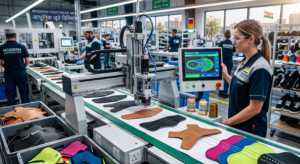
As production volumes continue to increase, manual marking becomes less practical for manufacturers aiming to deliver premium-quality footwear efficiently.
What Is an Automatic Stitch Line Marking Machine?
An Automatic Stitch Line Marking Machine is a digitally controlled system that accurately marks stitch guide lines on footwear upper components before the stitching process begins.
Using an industrial vision camera and precision positioning technology, the machine detects the material’s position and automatically applies accurate dotted guide lines. These markings assist stitching operators in maintaining uniform seam placement, resulting in cleaner, more consistent finished products.
By automating the marking process, manufacturers can significantly improve productivity while ensuring every component meets the required quality standards.
Key Advantages of Automatic Stitch Line Marking Machines
1. High-Precision Stitch Line Marking
One of the biggest advantages of an automatic stitch line marking machine is its ability to produce highly accurate and repeatable stitch guide lines.
Compared to manual marking, automated systems provide:
* Consistent line placement
* Improved stitching accuracy
* Better alignment of shoe components
* Uniform product quality across every production batch
This precision contributes directly to the overall appearance and durability of the finished footwear.
2. Increased Production Efficiency
Manual marking is a time-consuming process that can slow down production, especially in high-volume manufacturing.
Automatic marking machines help manufacturers:
* Increase production speed
* Reduce processing time
* Minimize operator intervention
* Improve workflow efficiency
The result is faster production without compromising quality.
⸻
3. Reduced Human Error
Manual operations can result in uneven markings, incorrect positioning, or inconsistent spacing between stitch lines.
Automated marking systems eliminate these issues by ensuring:
* Accurate positioning every time
* Repeatable marking quality
* Minimal operator dependency
* Reduced product rejection rates
This leads to more reliable manufacturing processes and fewer costly errors.
4. Superior Stitching Quality
Accurate stitch guide lines make it easier for sewing operators to maintain consistent stitching throughout the production process.
Benefits include:
* Straight and even stitching
* Better seam appearance
* Improved product aesthetics
* Enhanced finishing quality
High-quality stitching also strengthens the overall construction of the footwear.
⸻
5. Flexible for Different Footwear Designs
Modern footwear manufacturers often produce multiple designs, sizes, and collections within a single production schedule.
Automatic stitch line marking machines allow manufacturers to:
* Handle various footwear styles efficiently
* Adapt to different upper patterns
* Support frequent design changes
* Improve production flexibility
This makes them suitable for both mass production and smaller production runs.
6. Compatible with Multiple Materials
Today’s footwear industry uses a wide variety of materials that require accurate marking before stitching.
Automatic stitch line marking machines can work with materials such as:
* Genuine leather
* Synthetic leather
* PU
* PVC
* Microfiber
* Mesh fabrics
* Textile materials
This versatility allows manufacturers to produce diverse footwear collections using a single marking solution.
⸻
7. Improved Production Consistency
Consistency is essential for manufacturers supplying domestic and international footwear brands.
Automated marking ensures:
* Identical markings on every upper
* Consistent stitching quality
* Standardized production processes
* Reliable quality control
This consistency helps manufacturers maintain customer satisfaction and meet strict quality requirements.
8. Reduced Material Waste
Incorrect stitch line placement can lead to rejected components and unnecessary material loss.
By improving marking accuracy, manufacturers can:
* Reduce production defects
* Minimize rejected uppers
* Lower material wastage
* Improve overall production efficiency
Better material utilization contributes to reduced manufacturing costs.
⸻
9. Lower Labour Dependency
Since the marking process is automated, manufacturers can reduce dependence on highly skilled manual operators.
Benefits include:
* Simplified machine operation
* Reduced training requirements
* Consistent output regardless of operator experience
* Improved workforce productivity
Automation also helps address labour shortages in modern manufacturing environments.
10. Supports Smart Manufacturing
As footwear factories adopt Industry 4.0 technologies, automation plays an increasingly important role.
Automatic stitch line marking machines integrate seamlessly into digital production environments by supporting:
* Automated production workflows
* Digital pattern management
* Improved production planning
* Better process traceability
* Enhanced manufacturing efficiency
This helps manufacturers build smarter and more connected factories.
Benefits for Footwear Manufacturers
By adopting automatic stitch line marking technology, footwear manufacturers can achieve:
* Higher stitching accuracy
* Faster production cycles
* Improved product consistency
* Reduced material wastage
* Lower labour dependency
* Enhanced production efficiency
* Better product quality
* Greater manufacturing flexibility
* Improved profitability
* Increased customer satisfaction
These advantages help manufacturers remain competitive while meeting the growing demand for premium-quality footwear.
Applications
Automatic stitch line marking machines are widely used in the production of:
* Sports shoes
* Casual footwear
* Formal shoes
* Safety shoes
* Leather shoes
* Fashion footwear
* School shoes
* Sandals
* Boots
They are also suitable for marking components used in leather goods such as handbags, wallets, belts, and other accessories.