Why Are Dieless Cutting Machines Better for Cutting Synthetic Footwear Materials?
Introduction
The footwear industry is evolving rapidly, with manufacturers increasingly using synthetic materials such as PU (Polyurethane), PVC, microfiber, synthetic leather, mesh, knitted fabrics, and technical textiles. These materials offer excellent durability, design flexibility, and cost efficiency, making them popular choices for modern footwear production.
However, as consumer demands shift toward faster product launches, frequent design updates, and greater customization, traditional cutting methods often struggle to keep pace. This is where dieless cutting machines are transforming footwear manufacturing.
By eliminating the need for physical cutting dies, dieless cutting technology provides footwear manufacturers with greater flexibility, improved accuracy, reduced costs, and faster production cycles.
Challenges of Cutting Synthetic Footwear Materials
Synthetic footwear materials require precise cutting to maintain product quality and minimize material waste. Manufacturers often face challenges such as:
* Frequent design changes
* Multiple size variations
* Material wastage during cutting
* High tooling costs
* Faster sampling requirements
* Increased demand for customized products
Traditional cutting methods often involve additional time and expense whenever new designs or patterns are introduced.
What Is a Dieless Cutting Machine?
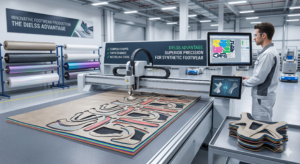
A dieless cutting machine uses digital cutting technology to cut materials directly from CAD patterns without requiring physical cutting dies.
Design files are uploaded into the software, and the machine automatically cuts the required shapes with high precision. This digital process allows manufacturers to move directly from design to production with minimal delay.
Key Advantages of Dieless Cutting Machines for Synthetic Materials
1. Elimination of Die Costs
One of the biggest advantages of a dieless cutting machine is that it completely removes the need for cutting dies.
In conventional production, every new shoe design requires a separate die, which results in:
* Additional investment
* Tooling expenses
* Procurement delays
* Maintenance costs
With dieless cutting, manufacturers can cut directly from digital files, significantly reducing operational costs.
2. Faster Sampling and Product Development
Footwear brands frequently introduce new collections and updated styles.
Dieless cutting machines allow manufacturers to:
* Create samples immediately
* Test new designs quickly
* Implement pattern modifications instantly
* Reduce product development time
This helps brands bring products to market faster and respond quickly to changing trends.
3. Excellent Flexibility for Multiple Designs
Modern footwear factories often produce numerous styles, colors, and sizes simultaneously.
Dieless cutting systems enable operators to:
* Change designs instantly
* Produce multiple patterns in a single production cycle
* Handle customized orders efficiently
* Support short production runs economically
This flexibility is particularly beneficial for fashion footwear and sports footwear manufacturers.
4. Improved Material Utilization
Synthetic materials such as PU, microfiber, and mesh represent a significant portion of footwear production costs.
Advanced dieless cutting machines use intelligent nesting software that:
* Optimizes pattern placement
* Maximizes material usage
* Reduces offcuts and waste
* Improves overall yield
Better material utilization directly contributes to lower manufacturing costs and higher profitability.
5. High Cutting Accuracy
Footwear components must fit together precisely during stitching and assembly.
Digital cutting technology provides:
* Consistent cutting accuracy
* Smooth cutting edges
* Improved repeatability
* Reduced human error
This ensures better component matching and higher-quality finished footwear.
6. Simplified Design Modifications
Fashion trends change quickly, requiring constant updates to footwear designs.
With a dieless cutting machine:
* Pattern changes can be made digitally
* New designs can be uploaded instantly
* Production can start immediately after approval
Manufacturers no longer need to wait for new dies to be manufactured, significantly improving responsiveness.
7. Reduced Storage Requirements
Traditional cutting operations require large storage areas for dies and tooling.
Managing these tools involves:
* Storage space
* Identification systems
* Maintenance procedures
Dieless cutting eliminates these requirements because all designs are stored digitally, helping manufacturers optimize factory space.
8. Lower Operational Costs
Physical dies require ongoing management throughout their lifecycle.
By eliminating dies, manufacturers can reduce:
* Tool inventory costs
* Maintenance expenses
* Replacement costs
* Administrative workload
This creates a more streamlined and cost-effective production process.
9. Ideal for Small-Batch and Customized Production
Consumer demand for customized footwear continues to grow.
Dieless cutting technology enables manufacturers to efficiently produce:
* Limited-edition collections
* Customized footwear
* Sample orders
* Short production runs
Since there are no tooling costs, even small quantities can be produced economically.
10. Supports Smart Manufacturing and Industry 4.0
Modern footwear factories are increasingly adopting digital manufacturing solutions.
Dieless cutting machines integrate seamlessly with:
* CAD systems
* CAM software
* ERP platforms
* Production planning software
* Digital workflow systems
Die-less cutting machines represent a significant advancement in the manufacturing process of synthetic footwear materials. By utilizing advanced technology, these machines enhance precision and efficiency while minimizing material waste. The ability to cut complex shapes without the need for traditional dies allows for greater flexibility in design and production. As the industry continues to evolve, die-less cutting technology will likely play a pivotal role in meeting the growing demand for sustainable and innovative footwear solutions.
This integration improves efficiency, traceability, and production control across the factory.
Benefits for Footwear Manufacturers
By adopting dieless cutting technology for synthetic materials, footwear manufacturers can achieve:
* Faster production cycles
* Reduced manufacturing costs
* Higher material utilization
* Improved cutting precision
* Greater design flexibility
* Faster response to market trends
* Enhanced product quality
* Improved operational efficiency
These advantages help manufacturers remain competitive in an increasingly demanding market.
Conclusion
As footwear manufacturing continues to move toward faster product development, customization, and digital production workflows, dieless cutting machines have become an essential technology for processing synthetic materials such as PU, microfiber, PVC, mesh, and technical textiles.
By eliminating the need for physical dies, reducing material waste, improving accuracy, and enabling rapid design changes, dieless cutting systems provide footwear manufacturers with a powerful tool to enhance productivity and profitability.
For companies seeking to modernize their production processes and stay ahead in the competitive footwear industry, investing in dieless cutting technology is a strategic step toward smarter and more efficient manufacturing.