New vs. Reconditioned Machines in the Leather Industry: Why New Machinery Is the Smarter Investment
Introduction
In the leather and footwear industry, machinery is not simply a purchase—it is a long-term investment that directly affects production capacity, product quality, operating costs and delivery commitments.
When purchasing machinery, manufacturers may consider reconditioned machines because of their lower initial price. However, the apparent saving can come with hidden costs and operational risks.
From unexpected breakdowns and inconsistent performance to outdated technology and difficulty in sourcing spare parts, reconditioned machinery can create challenges that affect the entire production process.
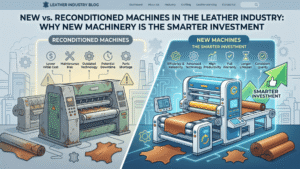
For manufacturers focused on reliable production, consistent quality and long-term growth, investing in new machinery is often the safer and more economical choice.
⸻
1. The Hidden Cost of Reconditioned Machines
The biggest attraction of a reconditioned machine is usually its lower purchase price.
However, the purchase price is only one part of the total investment.
A machine that requires frequent repairs, replacement parts or extended troubleshooting can quickly increase operating expenses.
The actual cost can include:
Purchase Price + Repairs + Spare Parts + Maintenance + Downtime + Production Losses
Therefore, a machine that appears cheaper initially may ultimately cost significantly more over its working life.
⸻
2. Unexpected Breakdowns and Production Downtime
One of the biggest risks associated with older or reconditioned machinery is unexpected breakdown.
Even after refurbishment, components that have already experienced years of operation may fail during production.
A breakdown can lead to:
* Production stoppage
* Delayed orders
* Missed delivery schedules
* Emergency repair costs
* Idle manpower
* Customer dissatisfaction
In a competitive industry, even a few hours of unexpected downtime can have a significant impact on productivity.
New machines reduce this uncertainty.
With new components and modern engineering, new machinery provides greater reliability and helps manufacturers maintain uninterrupted production.
⸻
3. Hidden Wear and Tear
A reconditioned machine may look clean and well-maintained externally, but its internal components may have experienced considerable wear.
Components such as:
* Motors
* Hydraulic systems
* Bearings
* Electrical components
* Sensors
* Valves
* Control systems
* Mechanical assemblies
may have already completed a significant portion of their service life.
Some problems may not become apparent until the machine is put under continuous production load.
With a new machine, manufacturers start with new components and a known machine history, significantly reducing uncertainty.
⸻
4. Inconsistent Performance and Accuracy
Leather and footwear manufacturing requires precision and repeatability.
Machines used for cutting, embossing, stitching, skiving and other operations must deliver consistent results throughout production.
Older machines may experience:
* Reduced accuracy
* Mechanical play
* Uneven pressure
* Inconsistent operation
* Increased rejection and rework
* Higher material wastage
New machines are designed to deliver consistent performance with modern components and control systems.
Better precision means better quality, less wastage and more predictable production.
⸻
5. Outdated Technology
Technology in the leather and footwear industry continues to evolve.
Older machines may not provide the automation, controls, efficiency and precision available in modern equipment.
This can result in:
* Lower productivity
* Greater dependence on manual operations
* Limited automation
* Higher operating costs
* Difficulty integrating with newer production systems
Investing in new machinery allows manufacturers to take advantage of current technology and modern production capabilities.
⸻
6. Difficulty in Finding Genuine Spare Parts
As machines become older, manufacturers may discontinue certain models and components.
This can make sourcing genuine spare parts increasingly difficult.
Manufacturers may have to depend on:
* Alternative components
* Locally fabricated parts
* Used spare parts
* Non-original components
These alternatives may affect machine performance and reliability.
With new machinery, genuine spare parts and technical documentation are generally easier to obtain, providing better support throughout the machine’s service life.
⸻
7. Higher Maintenance and Repair Requirements
Older machinery naturally requires more attention as components age.
Even after reconditioning, previously used components can require replacement sooner than expected.
This can result in:
More maintenance → More repair expenses → More downtime → Lower productivity
New machines generally require less corrective maintenance during their initial years, allowing manufacturers to focus on production rather than repeated repairs.
⸻
8. Limited Warranty and After-Sales Support
Warranty coverage is another important consideration.
Reconditioned machines may have limited warranty coverage compared with new machinery, depending on the supplier and machine.
A new machine from an established manufacturer or authorised supplier can provide greater confidence through:
* Manufacturer warranty
* Installation support
* Operator training
* Technical assistance
* Preventive maintenance
* Genuine spare parts
* Long-term service support
For production-critical equipment, dependable after-sales support is essential.
⸻
9. Safety Concerns
Older machinery may not incorporate the latest safety features available in modern equipment.
Over time, safety systems and components can also deteriorate or become outdated.
New machines are designed with modern safety considerations and can provide features such as improved guarding, emergency-stop systems, sensors and safer operating controls, depending on the machine.
Investing in safer machinery helps protect operators and supports a more secure production environment.
⸻
10. Higher Energy and Operating Costs
Older machines may use technology that is less energy-efficient than modern alternatives.
Even if the difference in energy consumption appears small, it can become significant when a machine operates for several hours every day.
Modern machinery can offer improvements in:
* Energy efficiency
* Motor performance
* Hydraulic efficiency
* Automation
* Production speed
Lower operating costs can contribute to better profitability over the machine’s working life.
⸻
11. Reconditioning Does Not Make a Machine New
One important point manufacturers should remember is that reconditioning and manufacturing a new machine are not the same thing.
Reconditioning generally involves inspecting, repairing, replacing selected components and restoring the machine to a usable condition.
A new machine, on the other hand, is manufactured with new components according to the manufacturer’s current specifications.
Therefore, reconditioning may improve the condition of an older machine, but it does not eliminate its age, previous operating history or the possibility of future component failures.
⸻
12. New Machines Provide Greater Production Confidence
For a manufacturing business, predictability is extremely valuable.
With a new machine, manufacturers can plan production with greater confidence because they are investing in:
* New components
* Modern technology
* Better accuracy
* Improved reliability
* Manufacturer support
* Warranty protection
* Better spare-parts availability
* Longer expected service life
This makes new machinery particularly valuable for businesses handling regular, high-volume production
⸻
The Real Question: How Much Does Downtime Cost Your Business?
When comparing machines, manufacturers should not ask only:
“How much does the machine cost?”
The more important question is:
“How much will this machine cost me throughout its working life?”
Consider the potential cost of:
* One major breakdown
* Several days of production loss
* Emergency spare parts
* Technician visits
* Rejected products
* Material wastage
* Delayed customer orders
* Lost business opportunities
When these factors are considered, the initial price difference between a new and reconditioned machine may become much less significant.
⸻
Why Choose New Machinery?
A new machine is more than a piece of equipment. It is an investment in productivity, quality, reliability and future growth.
By choosing new machinery, manufacturers can benefit from:
✅ Reliable Performance
Designed to deliver consistent performance from day one.
✅ Higher Precision
Modern engineering helps maintain accuracy and repeatability.
✅ Lower Breakdown Risk
New components reduce the uncertainty associated with previously used machinery.
✅ Modern Technology
Access to the latest automation, controls and production features.
✅ Better Safety
Designed with modern safety requirements and features.
✅ Warranty & Technical Support
Greater confidence through professional service and manufacturer support.
✅ Better Spare-Part Availability
Easier access to genuine components and technical assistance.
✅ Longer Service Life
A new machine provides a fresh operating life and greater long-term value.
⸻
Don’t Just Buy a Machine. Invest in Your Production.
Choose new machinery. Choose reliability. Choose precision. Choose long-term value.